

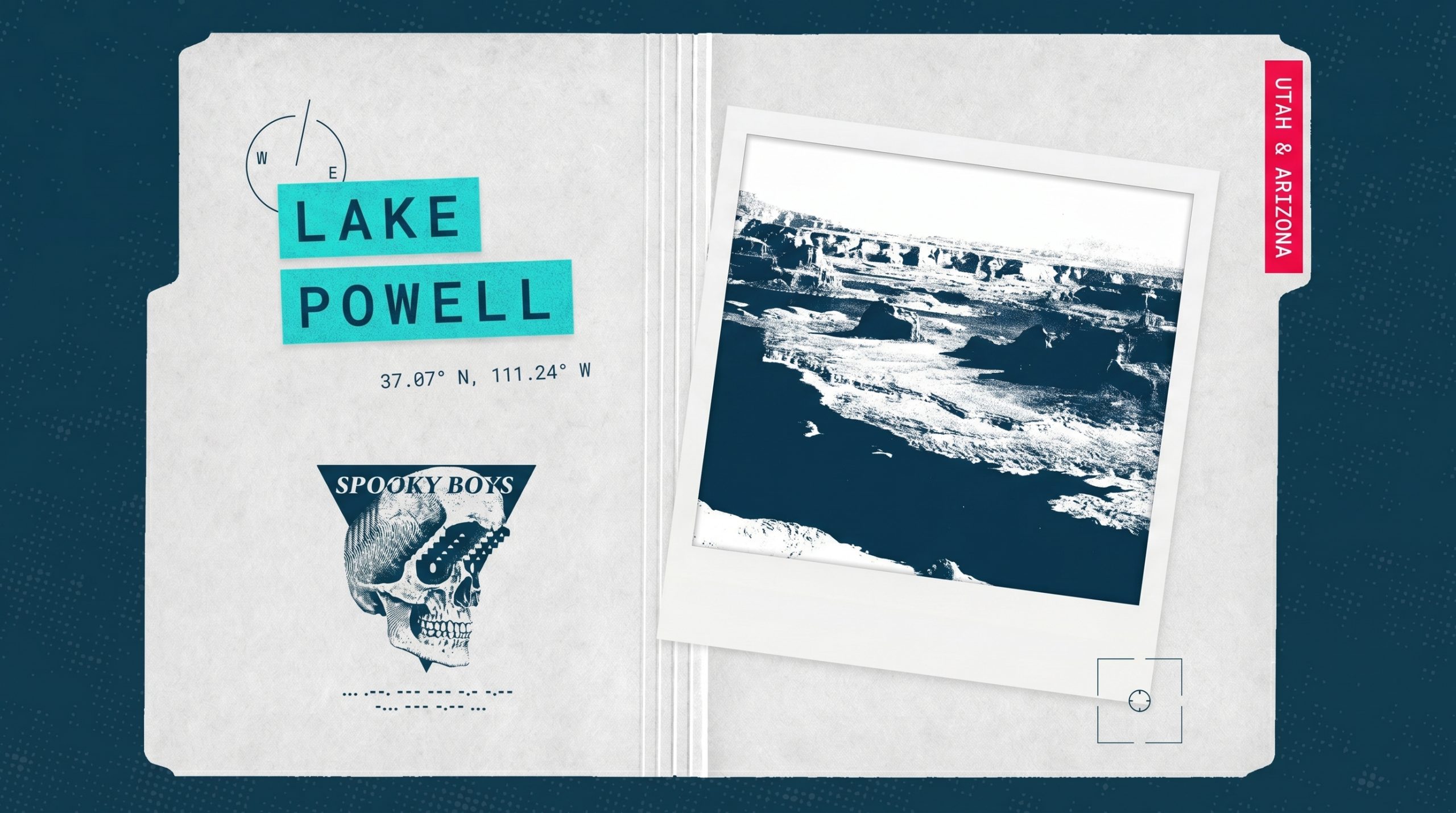
Glen Canyon did not need to be flooded. That is not a paranormal statement. It is the position of a significant number of geologists, conservationists, and historians who have spent time studying what was there before the water came and what was lost when it did. Glen Canyon was considered by many who saw it to be the most beautiful canyon system in the American West. David Brower, who led the Sierra Club at the time, called not preventing the flooding the greatest mistake of his life. The canyon walls had petroglyphs. Anasazi granaries tucked into unreachable ledges. Sacred sites used by the Hopi, Navajo, Paiute, and other Indigenous peoples for thousands of years before European contact. All of it went under when Glen Canyon Dam closed in 1963 and the Colorado River backed up into what became Lake Powell.
The flooding was not an accident. It was a decision. A specific decision made by specific people about specific ground that was understood by the people who had lived near it for millennia to be spiritually significant in ways that the decision makers either did not know or did not consider relevant.
The lake created by that decision now has a two million person annual visitation. People boat it, houseboat it, swim it, photograph it. It is genuinely spectacular in the way that drowned canyon country is spectacular, which is a specific kind of beauty that has tragedy built into the geology of every inch of it. The red walls going straight down into water. The slot canyons half-submerged. The high water marks showing how far the lake has shrunk during the ongoing drought, revealing shoreline that had been underwater for decades.
As the water has dropped, things have come back. Petroglyphs re-emerging from the water line. Archaeological sites that were assumed destroyed turning out to be intact, just submerged. Sacred sites reemerging. A Music Temple, a sandstone alcove that early explorers described as one of the most acoustically perfect natural spaces they had ever heard, visible again after fifty years under water.
The Fremont people who occupied the canyon system for centuries understood this landscape as sacred in ways that were specific and documented in their own visual language on the canyon walls. Some of those walls went underwater in 1963. Some of them are coming back now. What was written on them has been legible again for a few years after sixty years of submersion and what was written on them is still a question that is not fully answered. Scott has been looking at the documentation of the submerged and re-emerging petroglyph sites against his own research into the symbol sets that appear across Utah paranormal investigation locations and there are overlaps that he is not ready to discuss publicly. The document is in progress. It is connected to some other work he has been doing about the Fremont and what they encoded in their visual language about the specific landscapes they inhabited.
People drown in Lake Powell. More than at most recreational lakes. The numbers are documented and the documentation is uncomfortable because the rate has been consistently higher than comparable bodies of water for long enough that it is a statistical fact rather than a run of bad luck. The canyon walls go straight into deep water in ways that make distances deceptive and swimming conditions unpredictable. That is the official explanation and it is probably partially accurate.
The reports of sounds over the water at night are a different matter. Flute music. Laughter. Crying. Sounds that have no source and that visitors describe as coming from the water itself or from the canyon walls or from nowhere specific, just present in the air above the lake in the way that sounds in enclosed canyon spaces behave differently than sounds in open terrain. Whether those sounds are acoustic phenomena produced by the specific geology of drowned canyon country or something else is a question that has not been seriously investigated.
A sacred landscape submerged. Sacred sites flooded over. Petroglyphs written on canyon walls by people who understood the ground as spiritually charged, underwater for sixty years and now re-emerging. A lake with an anomalous drowning rate on top of all of that. Whatever the Fremont encoded in their visual language about this place, whatever the Navajo and Hopi and Paiute understood about this canyon system that caused them to treat it as sacred for thousands of years, did not wash away when the water came. Water doesn't neutralize what is in the ground. It covers it. It has been covered for sixty years and it is uncovering now.
The Spooky Boys have been to the Skinwalker Ranch area. Glen Canyon is the same general region, the same paranormal corridor, the Colorado Plateau landscape that multiple Indigenous traditions have documented as spiritually significant in ways that do not correspond to a single culture's interpretation but converge on the same conclusion from different directions. Scott does not think those convergences are coincidental. He has a folder on the Colorado Plateau specifically that he has been building for four years and that intersects with several other active research threads he is not prepared to connect publicly.
The lake is there. The canyon is under it and coming back. The flute music plays over the water at night and nobody who hears it can say where it comes from.
Some things were put into the canyon walls by people who knew what they were doing. The water covered them for sixty years. They are emerging again now.
Scott checks the water level reports the same Tuesday morning he checks the Great Salt Lake data.
The numbers are in the same spreadsheet.
 PeteWasThere
 WrenNotes
 Ben Caldwell
 TheoK
TheoK
 MaraV
MaraV
 Riley_Reads
 Kurt S.
 Phil
Phil
 Scott the Ghost King Boy