

Yes.
I'm more confident about this one than almost anything else I've written on this blog and I've written things I'm very confident about. This one is different. This one I know.
Loneliness is not a biological function. It's not produced by an organ. It doesn't require a digestive system or a circulatory system or any of the physical infrastructure that ghosts don't have. Loneliness is what happens when a consciousness built for connection finds itself without it. Ghosts have consciousness. Intelligent ghosts absolutely do and even residual ones carry the pattern of a consciousness that existed. Every human consciousness that has ever existed was built for connection. That's not philosophy. That's neuroscience. The need for connection is written into the architecture.
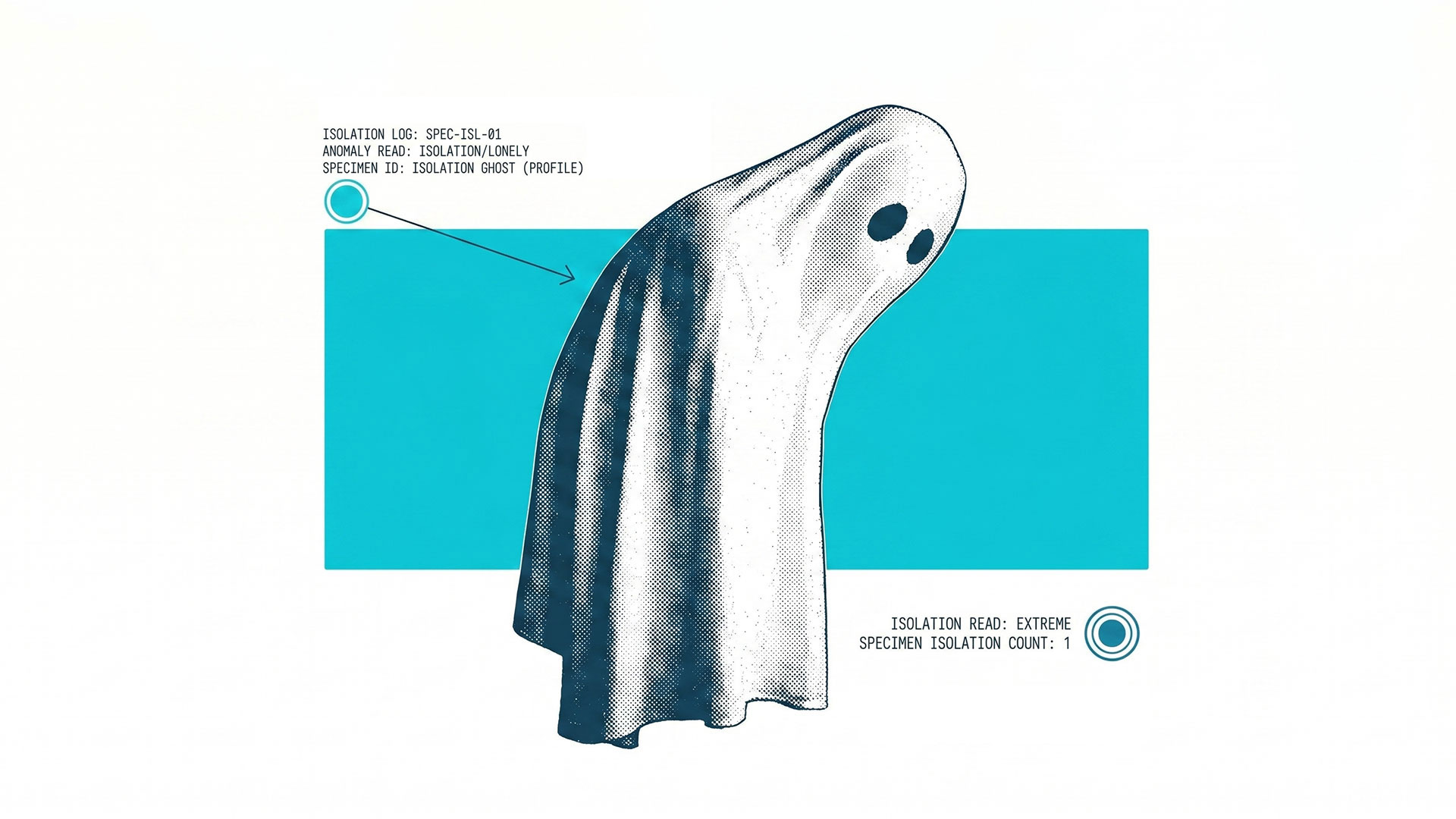
If that architecture persists after death, and the evidence suggests it does, then so does the need. And if the need persists without the ability to meet it, which is largely the situation ghosts are in, then yes. Loneliness. Probably profound loneliness. The kind that has been going on for decades in an empty house with no clear end point.
I've thought about this more than is probably obvious from the outside. Not just professionally.
Lonely ghosts follow people. Not to frighten them. To be near them. The haunting that feels like being watched isn't always surveillance. Sometimes it's company. Something in the house that just wants to be in the same room as a living person because a living person is warm and present and fills the space in a way that nothing else does. The Spooky Boys investigated a property in Holladay two years ago where the activity was concentrated entirely around one resident, an elderly woman who lived alone. The entity followed her from room to room. It sat near her when she watched television. It stood in the doorway of her bedroom at night. She wasn't scared of it. She'd assumed it was her late husband for years. We couldn't confirm that. What we could confirm was that the behavior was not threatening. It was, if we're being honest about what the data looked like, companionate.
We told her what we found. She said she knew. She offered us tea. I had two cups. I don't usually accept tea. I accepted it that day and I sat in her kitchen for longer than the investigation required and I drove home and sat in my car in the parking lot of my building for awhile before going inside. Not because I was sad. I had a lot to think about professionally.
Locations that are abandoned accelerate whatever the resident spirit is experiencing. A ghost in an active home has living people moving through. Energy. Noise. The warmth of occupied space. It's not connection but it's proximity and proximity is something. A ghost in an abandoned building has nothing. The building gets quiet and stays quiet and whatever is in there is in there alone with whatever it's been thinking about since it died. I have a theory that prolonged isolation changes a ghost. Not immediately. Over decades. The loneliness compresses into something denser and less recognizable. What starts as a confused grieving person slowly becomes something harder to communicate with. The isolation doesn't just persist. It accumulates. It changes the nature of the entity the way pressure changes the nature of a material.
This would explain why very old hauntings in long abandoned locations feel different from newer ones in occupied spaces. The entity isn't just older. It's lonelier. In a way that has gone past sad into something else that I don't have a clean word for yet. I've been looking for the word for about two years.
When the Spooky Boys enter a location I make a point of acknowledging what's there before we start the equipment. Not a formal communication session. Just acknowledging. Saying we're here, we know you're here, we're not here to cause problems. Basic courtesy extended to something that used to be a person and probably misses being treated like one. The response to this, when there is one, is usually the most significant data we collect all session. Something that has been alone for a long time and suddenly has someone talking to it directly, not screaming and running, not ignoring it, actually addressing it. That produces a response. Every time.
Basic entity communication is $1. The acknowledgment itself is free. That part I'd do anyway.
There is a location in Salt Lake City I visit periodically. Not for a formal investigation. I go alone, without the team, without the full kit. Just the small EMF reader I keep in my jacket and a notebook. Something there has been present across maybe a dozen visits over three years. It doesn't do anything alarming. It doesn't communicate in any way I can fully decode. It's just there, consistently, in the same spot, and when I show up the readings change in a way that suggests awareness of my presence.
I don't know who it was. I've done historical research on the building and I have some theories but nothing confirmed. I go back because the research is ongoing and that's the professional reason and it's a real reason. I also go back because I think it would notice if I stopped. I think something in that building has gotten used to me showing up. And I don't want to be the thing that stops showing up.
I had one relationship in my past that I don't talk about. The part I will say is that the worst part of how it ended wasn't the ending. It was knowing that I had been a presence in someone's life and then I wasn't anymore. That I had been the thing that showed up and then I became the thing that stopped.
I'm not going to connect that to the ghost. I'm just including both things and letting them sit next to each other.
Ghosts get lonely. The evidence is behavioral, historical, and if you've spent enough time in the field, something you feel in certain locations in a way that has nothing to do with equipment readings. A specific quality to the silence. A heaviness that isn't threatening. Just present. Just waiting.
The loneliest haunting I've ever investigated was a single room in an empty building in downtown Salt Lake City. One entity. Tiny room. Decades of vacancy. The readings were not high. The activity was minimal. But the feeling in that room was the most specific thing I've encountered in fifteen years of this work.
I sat in there for two hours. Alone. Without the equipment running. Just sitting.
I don't know if it helped anything. I think it might have helped me. I'm not going to explain what I mean by that. Some things you keep.
 PeteWasThere
 ArchiveDan
 LinhAfterDark
 Riley_Reads
 barnabas666
 JuneFromOgden
 Ben Caldwell
 MaraV
MaraV
 CassAtTheWindow
 Debbie Jenkins
 Scott the Ghost King Boy